
I was introduced to a brown version of a clouser tied with brown craft fur at the FFA Queensland Bass competitions on Lake Maroon over the week end. Fortunately I had some clousers tied with brown buck fur and along with a couple of other flies also tied in brown it certainly help me catch 24 of the total of 76 bass for the competition. I have tweaked the fly a little since I came home and I am sure that will make it work even better.
The Clouser in my view is the quintessential salt water fly. It can be tied in sizes to suit Bream or Bill fish and with the correct dressing and size is equally at home in salt water, trout and bass fisheries. Many flies whilst not acknowledging their heritage are based on the Clouser recipe. Have a good look at David Dodd’s Bream Fly or John Schofield’s Bass Vampire and you will see that at the very least they are influenced by the Clouser recipe and specifically dressed for Bream & Bass respectfully.
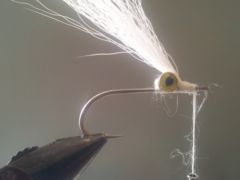
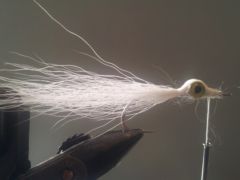
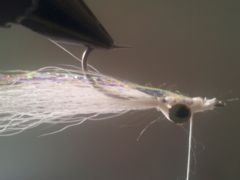
The original Bob Clouser recipe calls for the use of buck tail tail as the dominant dressing for the fly. It works very well but on the down side it’s not a durable fly and you may want to consider using more durable materials as in my synthetic clouser. Alternatively, as a minimum, add a little synthetic material on top of your buck tail to give it some protection.
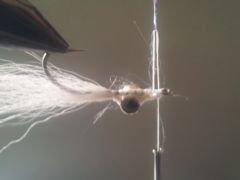
More often than not I also use bead chain eyes rather than “real eyes” or “dumb bell eyes” because I do loose a few flies fishing into snags and the bead chain eyes work just as well for me but of course cost almost nothing by comparison.
What ever your dressing do keep in mind that you need to ensure that the combination of the wing and the eyes do cause the fly to swim hook up when fished.
|
|
|
|
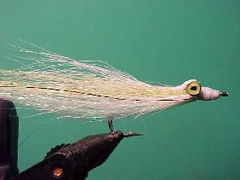
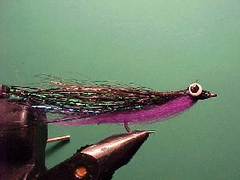
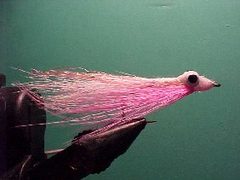
Materials for example below
| Hook | Thread | Tail / belly | Flash | Back |
|---|---|---|---|---|
| For saltwater I use Mustard 34007 Stainless steel but for my freshwater fishing I find that Gamagatsu B10S in sizes #2 to #6 a better option. | You will need a strong thread and I recommend “Uni big fly” thread. | A mixture of white buck tail and white synthetic material. | Pearl Flashabou or substitute. | Buck tail and/or similar coloured synthetic material. |
Process
| A |
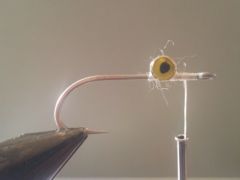
See [[Understanding hooks]] See [[Tying in dumbbell eyes]] |
 |
|---|
| B |
|
 |
|---|
| C |
See [[Tails on flies]] |
 |
|---|
| D |
|
 |
|---|
| E |
|
 |
|---|
| F |
|
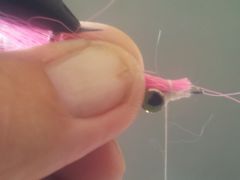 |
|---|
| G |
|
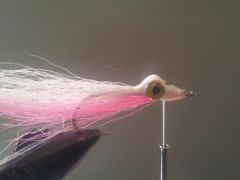 |
|---|
| H |
|
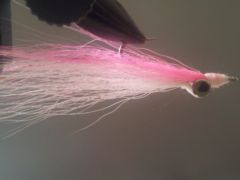 |
|---|