
This article deals with just one aspect of increasing your catch rate of barra in lakes and other barramundi impoundments and that is the influence of wind.
From my perspective wind influences barra in two ways:
- When barra will feed most actively.
- Where and why barra are likely to be in a given place at a given time.
When barra will feed most actively.
Barramundi look for aggregations of baitfish and in warmer months when water temperatures are in a comfortable range for both baitfish and barramundi and water movement created by wind (not temperature) dominates the movements of baitfish and consequently the movement of barramundi.
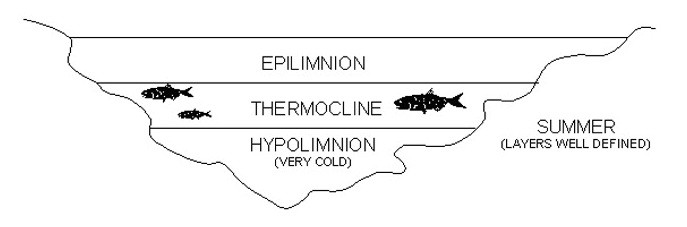
In summer the layers are quite distinct. There is generally a warmer “epilimnion” or top layer, a middle layer or “thermocline” and below that a layer at the bottom of the body of water called the “hypolimnion”. Both the top layer and the thermocline generally have adequate oxygen levels for both daphnia which bait fish eat, baitfish targeting the daphnia and of course Barra targeting baitfish. barra but the bottom colder level does not. So in summer barra often retreat to the thermocline which is a comfort zone providing both the best temperature and adequate oxygen content. Whilst in the thermocline there may also be supplies of food because daphnia, which are a small crustacean, also spawn in large numbers in the thermocline. When there is an absence of daphnia barra will of course leave the thermocline comfort zone to feed but of course will favour feeding areas which are easily accessed from those comfort zones. This is why in summer the best fishing is often in water adjacent to deep drop off’s or at dawn and dusk when water temperatures are a little lower and it’s often only during the cool of the night that barra venture into the shallower bays. As water heats up during the hotter parts of the day it becomes de-oxygenated and barra often retreat to the cooler better oxygenated water temperature of the thermocline. Having said that it should also be understood that as water temperature becomes hotter barra become more active and need more nourishment. So in summer whilst barra prefer the relative comfort of the thermocline they will leave it particularly at dawn and dusk to forage for food in less comfortable zones but from time to time they will return to their comfort zone.
 |
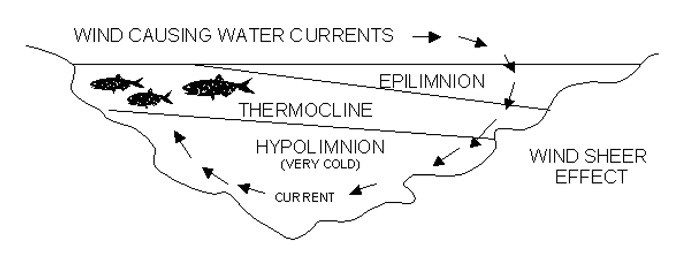
There are however times when the comfort of the thermocline is pushed to the surface creating situations where there is prolonged surface and sub-surface feeding activity. This occurs on windier days when there is a lot of water movement caused by wind created currents, colder water can be pushed to the surface by those currents. This wind sheer effect as it is called can result in the comfort zone for barra being extended to the surface allowing the barra to feed in what then becomes a well originated and relatively comfortable temperature surface zone for longer periods than would otherwise be the case. Often the wind sheer is on the lee side of a bay and this partially explains why there are often more fish on the surface during windy days than on calm days. This benefit of the wind shear is never on the protected side of the bay and in fact the thermocline there is often pushed deeper than it was before the wind came up. Keep in mind however that this effect is restricted to areas where there are large volumes of deep water and where the thermocline extends from shore to shore. This means that if you are seeking a sheltered location to fish on windy days you will benefit from fishing a protected bank in a large deep bay but you are unlikely to benefit from the benefits of wind sheer if you choose a less deep area protected from the main body of water by say a headland or point.
 |
Conversely, in cooler months when barramundi become uncomfortable in the cooler temperatures finding warmer water (not water movement carrying baitfish) becomes their dominating driving force.
Where barra are likely to be at a given time.
Barramundi definitely follow the movement of the water and if you want to catch fish you have to understand where the fish will be moving from and to so that you can position yourself where you can target them.
Barra are very economical with their energy and their preference is to expend as little energy as possibly whilst maintaining their nourishment and comfort. To accommodate this barra move around in the search of concentrations of food and or comfort.
If there is no wind or little wind, as a minimum you may find that the food which barra feed on is widely dispersed and not concentrated in pockets and lanes and consequently the barra are widely dispersed also. Worse still, except for the few resident fish that I have already mentioned the balance of the population of fish may not be there at all. The itinerant barra may still be where they were feeding when the wind dropped off. For example, if prior to the wind dropping off it was blowing away from the structure you have found it’s possible that the only fish that will be there are the few residents I mentioned earlier. Many of the other fish could quite easily be on the opposite side of the bay or lake cruising structure in that area either mopping up food that was blown there with the wind before it dropped or waiting for the wind to come back up and give them some expectation of where food will next concentrate. Wind lanes are an extreme example of influence of wind. They are an extremely variable form of structure and occur when the wind is split by some structure only to reform a some later point or where wind from slightly different directions converge. They can prevail for extended periods of time or may appear out of the blue and then disappear just as quickly. When they prevail they concentrate food into the area of convergence. At the same time the convergence also interferes with the prevailing surface effect of the prevailing wind on the surface of the water and creates flat spots and hopefully flat lanes of water that hold more food than the surrounding water that are easy for the fly fisher to see. The best wind lanes to fish are those that are long and thin and the best practice is to drift down either side of the wind lane and fish along the edge where it joins the main body of water. It should also be mentioned that the converging wind effect is not only on the surface of the water and often extends for several meters below the surface Fish are cognisant of the fact that converging wind increases the food supply in that area and generally travel up a wind lane toward the prevailing wind eating what they can either of the surface or in the wedge of water below the wind lane.
There are other reasons why barra may not be where you expect them to be. That’s where the irony of my discussion with my friends from Wollongong came in. Just like people, barra have physical needs other than food and those physical needs often dictate where the barra will be notwithstanding that it will put them well away from both the fixed and variable structure mentioned above. Whilst barra can tolerate a fairly broad range of temperatures and dissolved oxygen generally they are more comfortable in water temperatures of around 14 to 18 degrees Celsius and as a consequence spend most of their time in water around that temperature range if they have a choice. In lakes they do have a choice because the water stratifies into three distinct horizontal layers and maintaining contact with their comfort zone can often put them away from where you would otherwise expect them to be.
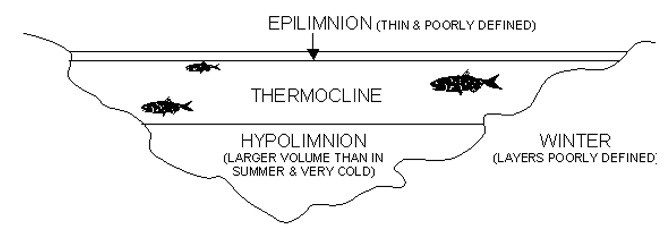
In winter as the water temperature drops more oxygen is dissolved making the water denser and heavier causing it to drop down to the thermocline and ultimately through to the bottom layer. The dropping water displaces less dense water and this constant turn over of water or circulation along with currents formed by the wind cause the horizontal strata of the water to be somewhat diffused and increases the vertical range of barra even though they may be less active because of the cold. As spring approaches and the days get longer the sun starts to heat the surface water making the barra a little more active. The early stages of this process coincides with the barra returning from spawning and seeking additional nourishment to put condition back on.
 |
 |
 |
 |
On closer observation some forms of structure are quite obvious and its identification can provide a good starting point for the search for elusive barra. The structure that we look for provides environments for two basic forms of things that barra eat.
The first is those food items that spend all or part of their life cycle in the water such as nymphs and their subsequent emergers and duns of various insects including in the case of lakes mainly mayfly, damselfly and caddis fly, crustaceans such as bony bream, garfish, other small fish, red claw and shrimp and tadpoles (and frogs if the water level doesn’t recede before the eggs hatch), snails and corixia. The relevant structure for these “aquatic” forms of trout food is by in large the fixed structure below the surface of the water.
weed beds, rocky undulations, drop off’s, drowned timber, mud beds where yabbies live, pockets of detritus matter where some nymphs live, sandy shore lines where some caddis live and of course the nature of the bank itself and adjacent vegetation.
The second form of things that barra eat is, small mammals such as mice, birds, terrestrial insects including grasshoppers, beetles, and cicadas etc. that find themselves in or on the water for one reason or another. These types of food items are of course more prevalent during summer months and their presence is related predominately to structure such as vegetation and topography above the surface of the water.
Both of these forms of structure are of course pretty easy to determine and except for changes caused by significant weather conditions or changes in water depth they will always be in the same position. If fixed structure is not visible then you can either identify it with the aid of a sounder or by word of mouth from somebody that knows the area better than you. If all else fails you can make some educated guesses based on your previous experience. That is to say that for example weed beds are generally in similar depths of water and in similar terrain. The same applies to rocky undulations. If it’s rocky along the shore or there are large boulders along the shore in all probability similar terrain will apply to adjacent waters. Also there is a lot to be said for searching these areas out for your self. If time permits its nice to develop your very own range of likely locations based on experiences built up over successive fishing outings. In any case once you have determined the locations you will be well on your way to locating suitable habitats for the things that barra eat and hopefully barra themselves. Having said that there is a lot of water mixed with the fish and just because you have found the structure doesn’t mean you have found fish.
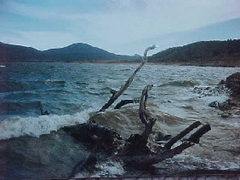
As well as blowing food onto the water surface wind creates both surface and sub-surface currents and those currents dictate where food will be concentrated, to some extent where the comfort zone of the barra will be, and consequently where fish are likely to be. The more wind the more chance there is of true terrestrials such as Beetles and Grass Hoppers being blown onto the water and of course the stronger both the surface and sub-surface currents will be. There is however a range of winds that it’s comfortable for fly fishing and I generally draw the line at winds above about 25 Km. Beyond that it is just plain uncomfortable and difficult to fish and unless everything goes right you can find yourself in more trouble than Ned Kelly. You can of course seek out wind protected areas such as the lee of islands and protected bays but you should keep in mind that its likely the fish will be where the wind is because it’s channelling food in one form or another into concentrated pockets. Any way it’s all a compromise. Rather than seeking out those sheltered bays one choice is to get the wind at your back and revert to “short lining”. The British developed this technique to deal with fishing windblown Scottish Lochs. It involves modifying your casting technique by starting with a short false cast with the wind and then a back cast and final forward cast as a contiguous sweeping arc-like motion which allows the wind to safely get your fly or flies into position albeit closer to you than perhaps would be the case on a calmer day with a normal cast. In windy conditions being close to your target isn’t as much as a problem as on calmer days because the turbulence on the water caused by the wind provides some visual protection. The offset of course is that if your too close to where your fishing you may spook fish. Fishing with the wind to your back does of course mean that any food that is being carried by wind and water currents will be quickly moving away from you. So its not always as easy as just finding the fixed structure to find fish. Whilst finding structure may be a good starting point there may be reasons why the fish are just not where you expect them to be.
If there is no wind or little wind, as a minimum you may find that the food which barra feed on is widely dispersed and not concentrated in pockets and lanes and consequently the trout are widely dispersed also. Worse still, except for the few resident fish that I have already mentioned the balance of the population of fish may not be there at all. The itinerant barra may still be where they were feeding when the wind dropped off. For example, if prior to the wind dropping off it was blowing away from the structure you have found it’s possible that the only fish that will be there are the few residents I mentioned earlier. Many of the other fish could quite easily be on the opposite side of the bay or lake cruising structure in that area either mopping up food that was blown there with the wind before it dropped or waiting for the wind to come back up and give them some expectation of where food will next concentrate. Wind lanes are an extreme example of influence of wind. They are an extremely variable form of structure and occur when the wind is split by some structure only to reform a some later point or where wind from slightly different directions converge. They can prevail for extended periods of time or may appear out of the blue and then disappear just as quickly. When they prevail they concentrate food into the area of convergence. At the same time the convergence also interferes with the prevailing surface effect of the prevailing wind on the surface of the water and creates flat spots and hopefully flat lanes of water that hold more food than the surrounding water that are easy for the fly fisher to see. The best wind lanes to fish are those that are long and thin and the best practice is to drift down either side of the wind lane and fish along the edge where it joins the main body of water. It should also be mentioned that the converging wind effect is not only on the surface of the water and often extends for several meters below the surface Fish are cognisant of the fact that converging wind increases the food supply in that area and generally travel up a wind lane toward the prevailing wind eating what they can either of the surface or in the wedge of water below the wind lane.
There are other reasons why barra may not be where you expect them to be. That’s where the irony of my discussion with my friends from Wollongong came in. Just like people, barra have physical needs other than food and those physical needs often dictate where the barra will be notwithstanding that it will put them well away from both the fixed and variable structure mentioned above. Whilst barra can tolerate a fairly broad range of temperatures and dissolved oxygen generally they are more comfortable in water temperatures of around 14 to 18 degrees Celsius and as a consequence spend most of their time in water around that temperature range if they have a choice. In lakes they do have a choice because the water stratifies into three distinct horizontal layers and maintaining contact with their comfort zone can often put them away from where you would otherwise expect them to be.
In summer the layers are quite distinct. There is generally a warmer “epilimnion” or top layer, a middle layer or “thermocline” and below that a layer at the bottom of the body of water called the “hypolimnion”. Both the top layer and the thermocline generally have adequate oxygen levels for barra but the bottom colder level does not. So in summer barra often retreat to the thermocline which is a comfort zone providing both the best temperature and adequate oxygen content. Whilst in the thermocline there may also be supplies of food because daphnia, which are a small crustacean, also swan in large numbers in the thermocline. When there is an absence of daphnia barra will of course leave the thermocline comfort zone to feed but of course will favour feeding areas which are easily accessed from those comfort zones. This is why in summer the best fishing is often in water adjacent to deep drop off’s or at dawn and dusk when water temperatures are a little lower and it’s often only during the cool of the night that barra venture into the shallower bays. As water heats up during the hotter parts of the day it becomes de-oxygenated and barra often retreat to the cooler better oxygenated water temperature of the thermocline. Having said that it should also be understood that as water temperature becomes hotter barra become more active and need more nourishment. So in summer whilst barra prefer the relative comfort of the thermocline they will leave it particularly at dawn and dusk to forage for food in less comfortable zones but from time to time they will return to their comfort zone.
|
There are however times when the comfort of the thermocline is pushed to the surface creating situations where there is prolonged surface and sub-surface feeding activity. This occurs on windier days when there is a lot of water movement caused by wind created currents, colder water can be pushed to the surface by those currents. This wind sheer effect as it is called can result in the comfort zone for troBut being extended to the surface allowing the trout to feed in what then becomes a well originated and relatively comfortable temperature surface zone for longer periods than would otherwise be the case. Often the wind sheer is on the lee side of a bay and this partially explains why there are often more fish on the surface during windy days than on calm days. This benefit of the wind shear is never on the protected side of the bay and in fact the thermocline there is often pushed deeper than it was before the wind came up. Keep in mind however that this effect is restricted to areas where there are large volumes of deep water and where the thermocline extends from shore to shore. This means that if you are seeking a sheltered location to fish on windy days you will benefit from fishing a protected bank in a large deep bay but you are unlikely to benefit from the benefits of wind sheer if you choose a less deep area protected from the main body of water by say a headland or point.
There are a number of other weather factors you should also consider. Barometric pressure is important as can be cloud coverage.
Trout are very economical with their energy and their preference is to expend as little energy as possibly whilst maintaining their nourishment and comfort. To accommodate this trout either establish territories or beats in areas where there is a good supply of food and access to comfortable holding zones or move around in the search of concentrations of food and or comfort.
hhhhhhhhhhhhhhhhhhhhhhhhh
The trout that establish territories or beats are generally brown trout and just as in rivers a hierarchical system prevails. The largest fish takes the best positions and smaller fish frequent lesser positions or move around looking for food and comfort. This is the same as in streams where the biggest fish take up station in the better positions, places where in relative terms a large amount of food passes and where they can hold without expending too much energy. Whilst we often refer to trout that have established territories or beats as resident fish it should be noted that they do move out of those positions and back to comfort zones at different times. So whilst finding structure may be like turning a light on in terms of expectation remember that there may not be anyone home.
The trout that move around over large areas in search of food are brown trout from down the hierarchical pecking order and of course most of the rainbow trout. These itinerant trout move around the lake or impoundment and resident fish retreat from their territories or beats as a result of a number of influences.
To increase your chance of finding trout it’s important to understand what those influences are and to make allowances for them. The most obvious influence I’m thinking about here is wind direction and intensity. I like to think of wind as a very variable form of structure.
As well as blowing food onto the water surface wind creates both surface and sub-surface currents and those currents dictate where food will be concentrated, to some extent where the comfort zone of the trout will be, and consequently where fish are likely to be. The more wind the more chance there is of true terrestrials such as Beetles and Grass Hoppers being blown onto the water and of course the stronger both the surface and sub-surface currents will be. There is however a range of winds that it’s comfortable for fly fishing and I generally draw the line at winds above about 25 Km. Beyond that it is just plain uncomfortable and difficult to fish and unless everything goes right you can find yourself in more trouble than Ned Kelly. You can of course seek out wind protected areas such as the lee of islands and protected bays but you should keep in mind that its likely the fish will be where the wind is because it’s channelling food in one form or another into concentrated pockets. Any way it’s all a compromise. Rather than seeking out those sheltered bays one choice is to get the wind at your back and revert to “short lining”. The British developed this technique to deal with fishing windblown Scottish Lochs. It involves modifying your casting technique by starting with a short false cast with the wind and then a back cast and final forward cast as a contiguous sweeping arc-like motion which allows the wind to safely get your fly or flies into position albeit closer to you than perhaps would be the case on a calmer day with a normal cast. In windy conditions being close to your target isn’t as much as a problem as on calmer days because the turbulence on the water caused by the wind provides some visual protection. The offset of course is that if your too close to where your fishing you may spook fish. Fishing with the wind to your back does of course mean that any food that is being carried by wind and water currents will be quickly moving away from you. So its not always as easy as just finding the fixed structure to find fish. Whilst finding structure may be a good starting point there may be reasons why the fish are just not where you expect them to be.
jjjjjjjjjjjjjjjjjjjjj
In winter as the water temperature drops more oxygen is dissolved making the water denser and heavier causing it to drop down to the thermocline and ultimately through to the bottom layer. The dropping water displaces less dense water and this constant turn over of water or circulation along with currents formed by the wind cause the horizontal strata of the water to be somewhat diffused and increases the vertical range of trout even though they may be less active because of the cold. As spring approaches and the days get longer the sun starts to heat the surface water making the trout a little more active. The early stages of this process coincides with the trout returning from spawning and seeking additional nourishment to put condition back on. The coincidence of these two timings helps explain why the late winter polaroiding can be so good on Lake Jindabyne and lake Eucumbene.
|
There are a number of other weather factors you should also consider. Barometric pressure is important as can be cloud coverage.
I don’t worry too much about the barometric pressure except to the extent of avoiding fishing when the barometric pressure is changing quickly. I think quick changes in barometric pressure put fish down and off their tucker. Generally the higher and more stable the barometric pressure the better. You don’t often get ideal barometric pressure conditions and I regard any barometric pressure that is above average and reasonably stable as acceptable.
Cloud cover is an interesting phenomenon and of course influences the fly fishers choice of technique. Clear bright days are best for sight fishing but although it’s very pleasant for the fly fisher on the water on those sorts of days shadows cast by your boat, your rod and yourself will be problems and in any case trout will probably be keeping out of the sun. Constant cloud cover creates the best of conditions for blind fishing or prospecting and as long as you don’t mind getting wet then a light rain is good as well. In these conditions shadows are not a problem and when combined with a light breeze and structure it’s likely that fish will be freely moving about feeding and they won’t even see you unless you make yourself obvious.
The conclusion I have reached over time is it is essential to avoid thinking of lakes as homogeneous bodies of water. If you take into account the factors that dictate where trout are holding your chances of success will increase. Fixed structure in the water is a great starting point but always take into account factors like the riparian environment and structure, water temperature and dissolved oxygen, what influences the wind, cloud cover and sun are having on the trout’s environment and if you have a choice even consider the barometric pressure.
There is of course the fixed structure such as drowned timber, rocky bar and outcrops, weed banks and points. Theses types of structure are quite obvious and can provide a good starting point for the search for elusive barra.
The second form of structure, if you like, is all those items that are on the barra’s menu.
The structure that we look for provides environments for two basic forms of things that barra eat. That is generally broken down into two classes.
The first class is those food items that spend all or part of their life cycle in the water such bony bream, small barred grunter, snub nose garfish and red claw yabbies and in turn for that smaller fish their food items such as nymphs and their subsequent emergers and duns of various insects including in the case of lakes mainly mayfly, damselfly and caddis fly, crustaceans such as yabbies, scud and daphnia, small fish such as galaxia and other smaller fish, smaller barra and red claw, tadpoles and frogs, snails and corixia. The relevant structure for these “aquatic” forms of barra food is by in large the fixed structure below the surface of the water and in particular the heathy weed banks.
The second form of things that barra eat is the terrestrial insects including grasshoppers, beetles, and cicadas etc. that find themselves in or on the water for one reason or another. These terrestrial insects are of course more prevalent during summer months and their presence is related predominately to structure such as vegetation and topography above the surface of the water.
Barra also eat bigger life forms and that includes frogs, water foul chicks, other small birds and bird chicks, smice and lizards that inadvertently find themselves on or in the water.
Both of these forms of structure are of course pretty easy to determine and except for changes caused by significant weather conditions or changes in water depth they will always be in the same position. If fixed structure is not visible then you can either identify it with the aid of a sounder or by word of mouth from somebody that knows the area better than you. If all else fails you can make some educated guesses based on your previous experience. That is to say that for example weed beds are generally in similar depths of water and in similar terrain. The same applies to rocky undulations. If it’s rocky along the shore or there are large boulders along the shore in all probability similar terrain will apply to adjacent waters. Also there is a lot to be said for searching these areas out for your self. If time permits its nice to develop your very own range of likely locations based on experiences built up over successive fishing outings. In any case once you have determined the locations you will be well on your way to locating suitable habitats for the things that barra eat and hopefully barra themselves. Having said that there is a lot of water mixed with the fish and just because you have found the structure doesn’t mean you have found fish.