Over the years I have tried several different types of poppers … this particular popper ticks all the boxes for me when it comes to non-articulated poppers and it’s a recipe I can easily adapt to tie it in three different sizes to target 3 different size classes of fish.
- For bream I use Sybai 10mm & 12mm popper heads and Gamakatsu 90RB hooks in sizes #4 and #2. Bream react to poppers for one of two reasons. The fist is that bream interpret the popper as a prawn, shrimp or small fish on the surface or a terrestrial insect that has found itself on the surface. The other is that they get their knickers in a knot and they strike out of aggression. Colour is not so important for bream as it’s generally the surface action they react to rather than the colour.
- For bass my default colour is black and I tie it on Gamakatsu 90 RB hooks from size #1 to #1/0 using Wapsi size #1 “perfect popper heads”.
- For mangrove jack I tie it in the heavier Gamakatsu 90HW hooks in sizes #2/0 and #3/0. (The HW stands for ‘heavy wire’ that are designed to contend with the strikes of bigger fish and in particular mangrove jack and occasionally fingermark.) The popper I use for these flies is the Flymen Double Barrel Large Surface Popper Head and I tie an orange version for use in the sun and black for use on dull days, dusk & dawn
Whilst you can make your own popper heads out of cork or foam I prefer to buy pre-formed closed cell popper heads as described above because they are always symmetrical. I now only buy the three popper heads in white as all three have a hard and smooth easily paintable surface.
I also always put eyes on my poppers because I think they area trigger point for fish. I always uses dolls eyes that are cheap and available from haberdashery or craft shops. As an alternative you can of course use holographic eyes or simply paint eyes on.
Materials
| Hook |
Thread |
Head |
Eyes |
Tail |
Body |
Legs |
| Gamakatsu Jig 90 RB or HW as described above |
Uni 3/0 up to size #2 and 100 Denier above that. |
Popper heads described above |
Stick on dolls eyes |
Marabou and sparkle flash |
Estaz chenille or equivalent |
Rubber or silicon legs |
Process
| A |
- Tie the thread in just behind the eye post and wind it down the first 2/3 of the hook shank in touching turns.
See [[Understanding hooks]]
- Tie the cotton off with a couple of half hitches and trim the excess.
- Using cotton rather than fly tying thread, together with the super glue to attach the popper head will provide a foundation for the fly that will stand the test of time and the rigours of solid hook ups.
|
 |
| B |
- Put a couple of drops of super glue on the thread on the front half of the hook shank.
- Make sure the popper is aligned with the hook properly and push the pre-formed popper head onto the hook shank with the eye post just inside the popper head and the eye of the hook protruding out just below the front rim of the popper head.
- Turn the fly over and fill the gap in where the hook was fixed with just 1 or 2 drops of super glue.
- Put a strip of sticky tape on each of the two fingers that you will use to squeeze the fly with and then gently squeeze the 2 sides of the popper together. Hold them together until the super glue goes off which is generally just 20 seconds or so. If you don’t put sticky tape on the 2 fingers you squeeze the popper head together with your fingers may stick to the popper and I find that when you finally get released from the popper the skin that you loose doesn’t look as good on the popper as it did on you fingers.
|
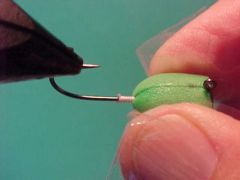 |
| C |
- Put pen marks on the side of the head where you want to attach the eyes. It’s no good trying to work out where you want the eyes once you apply super glue to the eyes because they will attach to the first pace you touch them even if it’s not quite right. If the eyes do finish off a little off centre, when you do this for the first time, don’t worry to much as I don’t think bass are as fussy as we are.
|
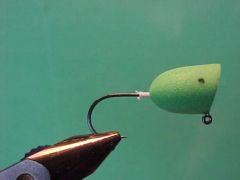 |
| D |
- Put a little tape with the sticky side out on the point of a tooth pick and use that to pick up a doll eye from the front side. Put a drop of glue an the back of the eye and with it still attached to the tooth pick use the tooth pick to position the eye on the first pen spot on the side of the popper head. Hold it there for around 20 seconds until the super glue goes off.
- Repeat that process for the second eye.
See [[Eyes on flies]]
|
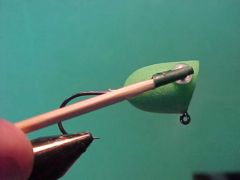 |
| E |
- Still with the sticky tape on your fingers gently squeeze the eyes so that they firmly attached to the popper head. This also only takes about 20 seconds.
- Carefully disguard the sticky tape taking care not to get any of the glue on your fingers.
|
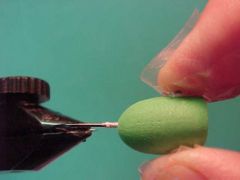 |
| F |
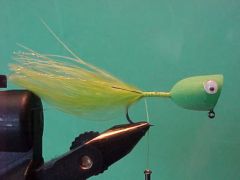
- The tail is an important element of the fly as it is responsible for helping the popper swim properly and with the legs adds movement to the fly.
- Many types of tails including Dahlberg Diver, Deceiver and zonker tails suit poppers but I am very happy with a woolly bugger type tail and I like them to be about one to one and a half times the length of the hook.
See [[Tying in woolly bugger type tails]]
|
 |
| G |
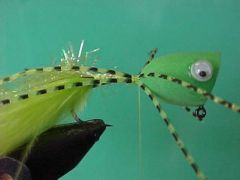
- Tie in a length of estaz chenille at the bend of the hook.
- Tie in two sets of legs “Chernobyl” style on each side of the fly.The easiest way to tie legs in is to hold the leg material for the two legs on the front side of the popper along the side of the fly with the same amount either side of the thread and then take a couple of wraps of thread to lock the legs into position.
- Turn the fly over in the vice and tie the two legs for the other side of the fly in at the same position.
|
 |
| H |
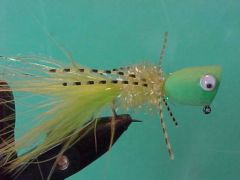
- Hold the rear facing legs forward and wind the estaz chenille forward in touching turns until you reach where the legs are tied in.
- Now pull the rear facing legs back and take one turn of the estaz chenille over the thread that tied in the legs.
- Finally pull the forward facing legs back out of the way and take one or two turns of the estaz chenille in front of the legs and directly behind the popper head.
- Tie the chenille off directly behind the popper head, trim the excess chenille and whip finish behind the popper head.
- Trim the excess thread and add a drop of super glue to the whip finish.
|
 |
